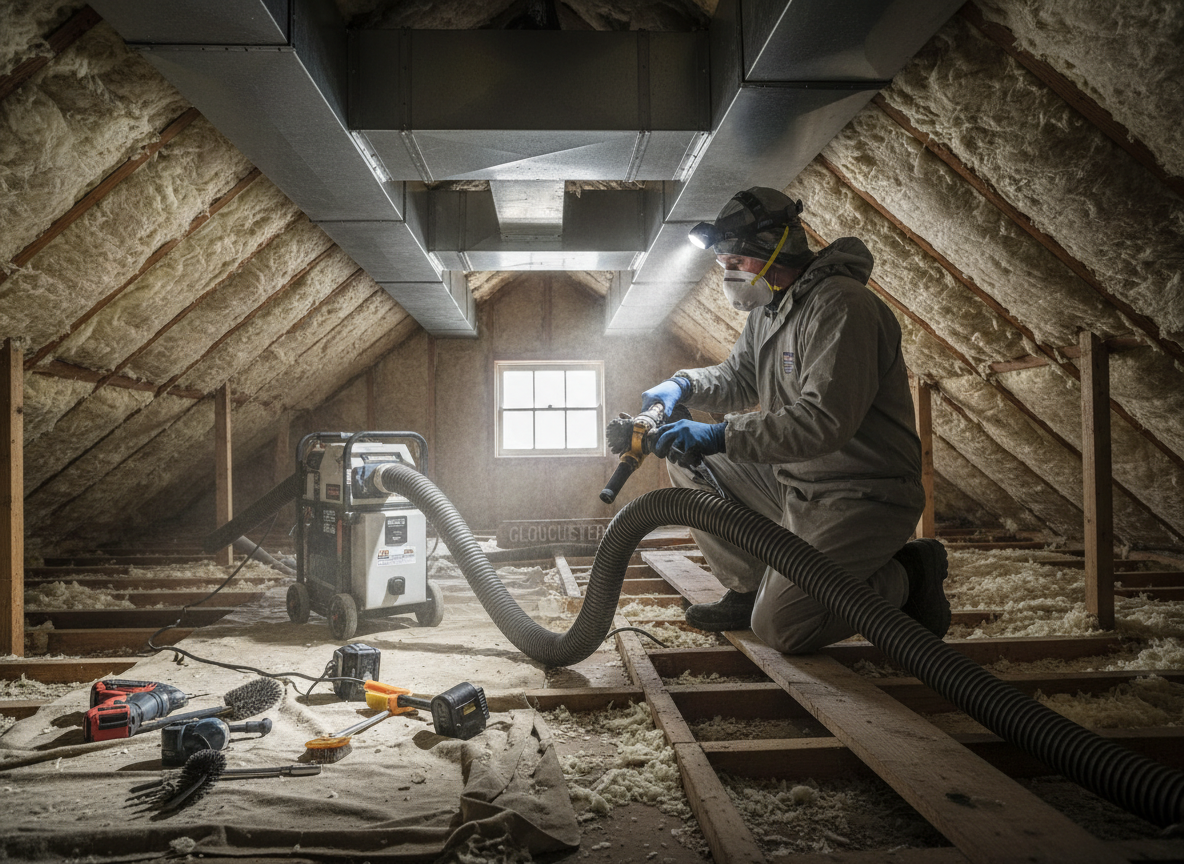
Gloucester City features many early-20th-century brick and frame homes with galvanized steel duct runs that run through tight basements and crawlspaces. These systems collect fine silt from the nearby Delaware River waterfront plus everyday household dust. Over time the buildup restricts airflow and recirculates allergens, especially after humid summer months when moisture encourages mold on cooler duct surfaces. A proper cleaning uses negative-air machines and rotary brushes sized for the narrow 6- and 8-inch branch lines common in these older layouts rather than generic truck-mounted equipment.
Homeowners along Johnson Boulevard and in the Brooklawn section often call after noticing uneven heating or musty odors that worsen in winter when furnaces run continuously. We start every job with a camera inspection to map the actual duct paths, because many properties have had additions that created dead legs or sharp turns not shown on original plans. Removing debris without damaging the thin metal seams requires controlled vacuum pressure and hand-access ports cut only where needed, then resealed to code. Skipping this step leaves hidden pockets that continue to shed particles.
After cleaning we always check the return-air filter housing and blower compartment because river-area pollen and construction dust from nearby I-295 projects quickly recontaminate freshly cleaned ducts if those components are neglected. The result is measurable improvement in airflow and reduced dust on surfaces within days, without any claim of medical benefits or system efficiency percentages we cannot verify on site.
Technician insight
In Gloucester, the thing that catches most people out with professional air duct cleaning is the narrow crawlspaces under 1920s-1940s homes near the river where low clearance and offset duct turns make full brush access impossible without cutting extra ports; skipping those hidden sections leaves the job half done.
Gloucester City Row Home Ducts
Homeowner reported persistent dust on furniture despite frequent vacuuming. Camera showed heavy lint and river silt in the main trunk feeding the second floor. We isolated the system, agitated and extracted debris through two new access points, then resealed everything. Airflow improved noticeably and the musty smell disappeared.
How it works
- 1
Initial Camera Inspection
We run a flexible scope through every accessible trunk and branch to document blockages, moisture, and layout quirks typical of Gloucester City housing stock.
- 2
Containment and Equipment Setup
Negative-air machines are positioned at the main trunk while we seal registers to prevent dust migration into living spaces during agitation.
- 3
Mechanical Cleaning
Rotary brushes and compressed-air whips dislodge debris from galvanized ducts without damaging seams common in pre-1960 homes.
- 4
Final Vacuum and Verification
A second camera pass confirms removal, followed by re-sealing of any access points and return of the system to normal operation.
Pricing
Cost depends on number of runs, access difficulty in older Gloucester basements, and whether the system has been previously cleaned; we provide an upfront quote after the inspection.