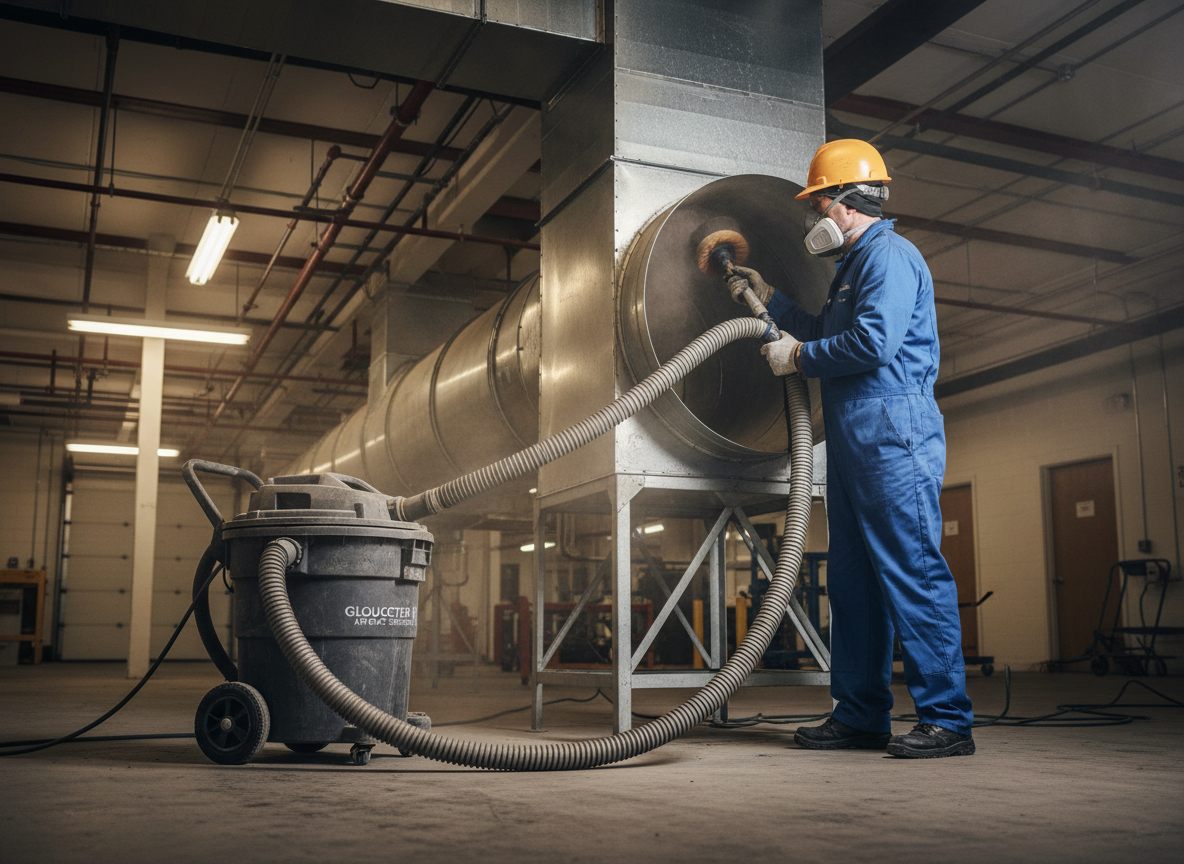
Gloucester City commercial buildings often date to the early 1900s through 1960s, with duct runs that combine original sheet metal, later flex additions, and rooftop units exposed to Delaware River humidity. These mixed systems trap grease, paper dust, and construction debris from nearby port and warehouse activity. Cleaning crews must map every trunk and branch before starting because blocked dampers or collapsed sections are common in buildings that have changed tenants multiple times.
Access is the main variable. Many downtown storefronts and light-industrial sites have ceilings dropped over original ductwork, requiring ceiling tile removal and careful reinstallation. Rooftop units serving multi-tenant buildings frequently lack service platforms, so ladders and fall protection add time. Technicians also check for asbestos-wrapped insulation still present in structures built before 1980, stopping work and notifying the property manager when it appears.
Negative-air machines with HEPA filtration are run at full volume for the entire job to keep dislodged particles from migrating into occupied spaces. After brushing and vacuuming, registers and diffusers are removed, washed, and reinstalled. A final camera sweep documents cleared sections and any remaining damage that needs separate repair.
Post-clean testing includes static pressure readings at the unit and a visual check that all dampers move freely. Gloucester’s frequent temperature swings can cause metal ducts to expand and contract, loosening joints that were tight before cleaning, so crews note any new gaps for the building engineer.
Technician insight
In Gloucester, the thing that catches most people out with Commercial Air Duct Cleaning is the mix of original sheet-metal ducts and later flex runs hidden above old drop ceilings in buildings along the river. Once you start pulling sections, you often find collapsed flex or dampers frozen from years of port-area dust and humidity cycles. That turns a half-day job into a full day before you even touch the rooftop units.
Riverside Office Building
A two-story office near the Gloucester City waterfront had never had its ducts opened since a 1998 tenant fit-out. Heavy paper dust from a printing tenant on the first floor was migrating upstairs. We mapped the mixed rigid and flex runs, set up containment, and removed thick layers of debris plus several collapsed flex sections. After cleaning and new flex replacements, the building manager reported noticeably steadier airflow and fewer complaints from upstairs staff.
How it works
- 1
Site Assessment
Walk the building, locate every air handler and trunk line, note access points and any visible damage or insulation concerns.
- 2
Containment Setup
Place negative-air machines with HEPA filters at each return and seal off work zones so dust stays inside the ducts.
- 3
Mechanical Cleaning
Use rotary brushes and compressed-air whips sized to each duct diameter, followed by continuous vacuum extraction.
- 4
Register Service and Verification
Remove, clean, and reinstall all diffusers; perform camera inspection and static-pressure test to confirm airflow restoration.
Pricing
Commercial pricing is quoted after an on-site assessment because system size, access difficulty, and number of air handlers vary widely between Gloucester properties.