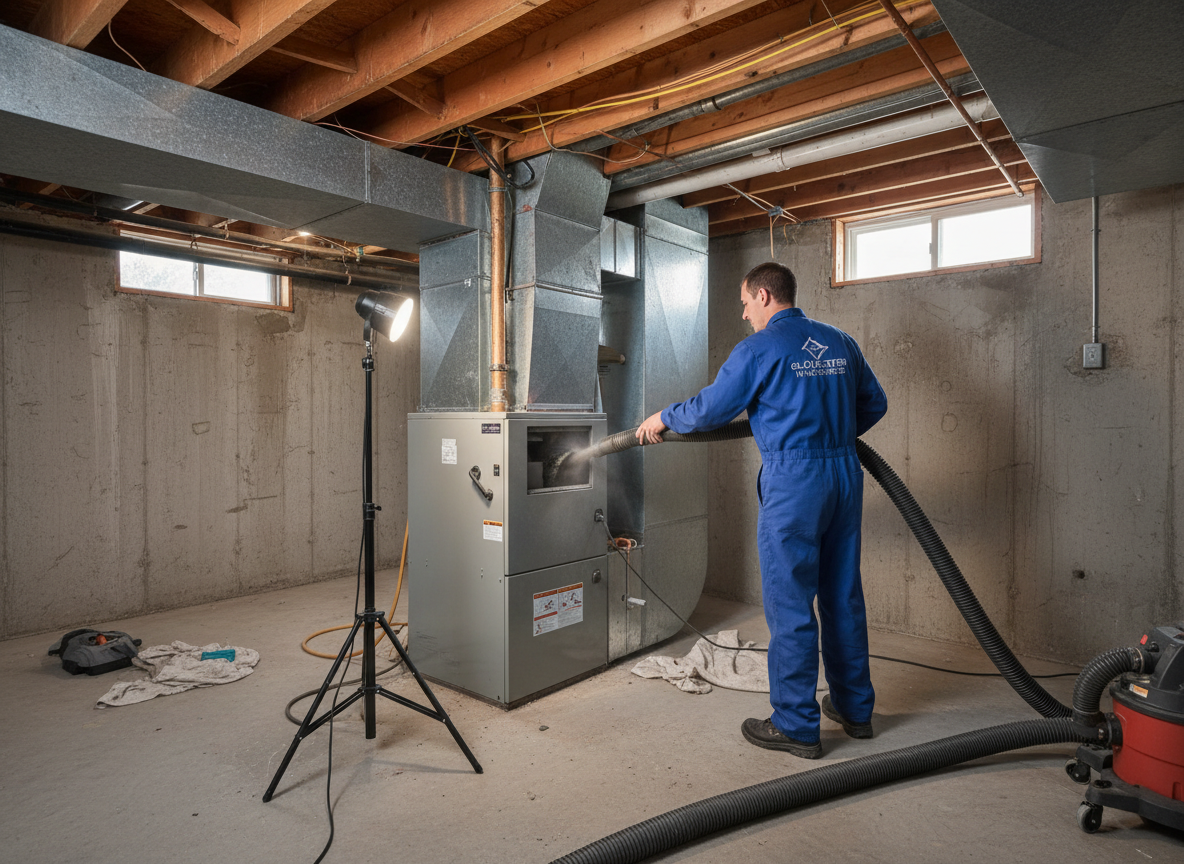
Gloucester City housing stock includes many pre-1960 single-family homes and row houses where furnace ductwork often runs through tight basements and crawl spaces. These systems collect fine dust, insulation fibers, and construction residue that standard filters miss. When winter temperatures drop along the Delaware, restricted airflow forces furnaces to run longer cycles, raising energy use and risking uneven heat in upstairs rooms. Cleaning focuses on reaching trunk lines and branch runs without disturbing original plaster or floor joists common in these properties.
Moisture from the river corridor combines with household dust to create sticky buildup inside supply ducts near the furnace plenum. Technicians remove access panels carefully to avoid damaging older sheet-metal seams, then use brushes sized for narrow Gloucester City duct runs. After agitation, high-volume vacuum collection prevents particles from re-entering living spaces. Homeowners in areas like Mount Ephraim Road or along Broadway notice improved airflow once the main return and furnace blower housing are cleared of the compacted layer that forms after decades of use.
Edge cases appear when ducts pass through unconditioned attics added during later renovations; temperature swings here can loosen debris that later migrates back into registers. Proper cleaning includes checking for disconnected sections or crushed flex runs hidden behind finished walls, which are frequent in Gloucester's older neighborhoods. Work stops immediately if active mold or pest evidence appears so the homeowner can arrange separate remediation before resuming.
After the job, registers are wiped and the furnace is run through a test cycle to confirm static pressure returns to normal range. This step reveals any remaining restrictions that would otherwise cause short cycling once cold weather arrives.
Technician insight
In Gloucester, the thing that catches most people out with furnace and duct cleaning is how the older plaster and lath homes along the river trap dust in low, narrow returns that newer equipment can't reach without custom brushes.
Blocked Return in Gloucester City Row Home
Homeowner reported weak heat on the second floor during early cold snap. Inspection found the main return choked with decades of fine dust and pet hair. Crew opened the basement trunk, agitated the line, and extracted the material. Airflow improved and the furnace stopped short-cycling.
How it works
- 1
Initial System Inspection
Technician examines furnace, return, and supply runs to identify access points and note any damaged sections in Gloucester homes.
- 2
Access Panel Removal
Panels are opened at the plenum, main trunk, and key branches without cutting original ductwork.
- 3
Agitation and Extraction
Rotating brushes and compressed air dislodge debris while negative-pressure vacuum collects it at the source.
- 4
Final Airflow Check
Furnace is restarted and static pressure is measured to confirm restored flow before panels are replaced.
Pricing
Cost depends on number of runs, furnace location, and access difficulty in older Gloucester City homes; quotes provided after inspection.